Integrating Art Historical Knowledge into AI-Based Authorship Detection in Jan van Eyck’s Saint Francis Receiving the Stigmata
Veröffentlichungsdatum: 13 Jul 2026 11:39
Zitierbare Links:
URN: urn:nbn:de:bvb:355-kuge-638-2
Download:
![[img]](https://www.kunstgeschichte-ejournal.net/style/images/fileicons/application_pdf.png) | PDF Download (4MB) Sprache: Deutsch |
Durchschnittliche Beurteilung
Ihre Beurteilung
Abstract (englisch)
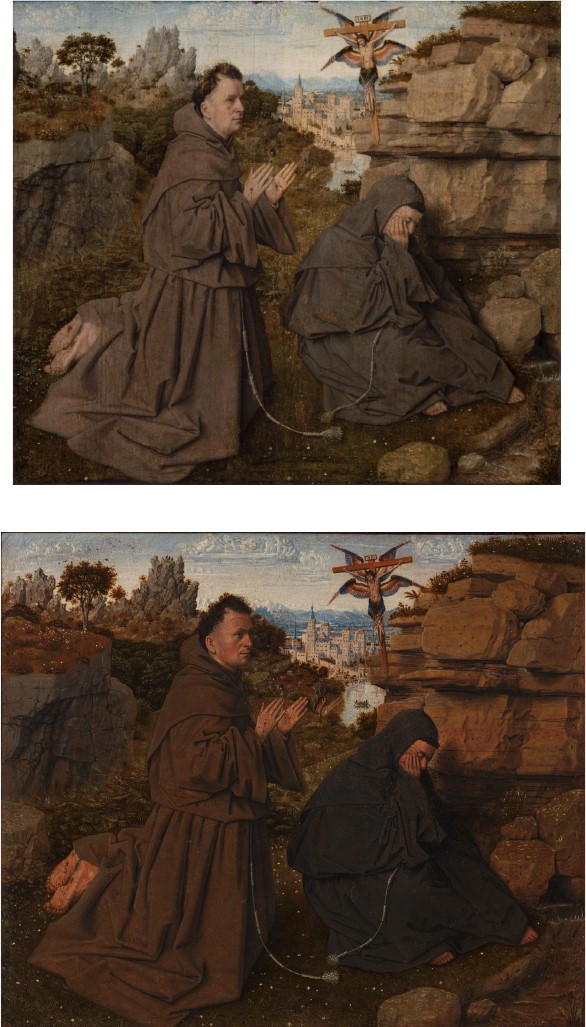
This article examines the application of artificial intelligence to one of the controversial attributions in Early Netherlandish painting: the two fifteenth-century panels depicting Saint Francis Receiving the Stigmata, traditionally associated with Jan van Eyck and today in museums in Turin and Philadelphia. Combining art historical inquiry, conservation history, and computational image analysis, the study investigates how AI authenticity assessment can contribute to longstanding questions concerning authorship. In the case of the Turin painting, the AI analysis initially produced a negative likelihood of Van Eyck’s authorship when applied to the painting in its current visible state. However, when areas affected by restoration were digitally excluded from the image, the authenticity probability changed from strongly negative to positive. By contrast, the Philadelphia panel consistently received low authenticity probabilities under all testing conditions, with minimal variation between the analysis of the full visible image and the digitally adjusted version excluding restored areas. However, since the Philadelphia version is painted on parchment that was mounted on oak, these computational results are most likely not the last word in the debate. Our findings highlight the importance of dataset construction, restoration and conservation history, and workshop complexity in the development and interpretation of AI authentication models, suggesting that artificial intelligence may be useful for approximating complex attributional problems when understood not as a source of definitive verdicts, but as an additional interpretative instrument within art historical research.
Lizenz
Jedermann darf dieses Werk unter den Bedingungen der Creative Commons Namensnennung 3.0 DE Lizenz benutzen.

Bilder können von dieser Lizenz abweichen.
Information
Zitierbare Links:
URN: urn:nbn:de:bvb:355-kuge-638-2
Lizenz
Jedermann darf dieses Werk unter den Bedingungen der Creative Commons Namensnennung 3.0 DE Lizenz benutzen.
Bilder können von dieser Lizenz abweichen.
empfohlene Zitierweise:
Borchert, Till-Holger und Conti, Alessandra und Düzgün, Batu Arda und Popovici, Carina: Integrating Art Historical Knowledge into AI-Based Authorship Detection in Jan van Eyck’s Saint Francis Receiving the Stigmata. In: Kunstgeschichte. Open Peer Reviewed Journal, 2026 (urn:nbn:de:bvb:355-kuge-638-2)
Bitte geben Sie beim Zitieren dieses Artikels die exakte URL und das Datum Ihres letzten Besuchs bei dieser Online-Adresse an.




Rezensionen
Kommentare
Es liegen noch keine Kommentare vor.Möchten Sie Stellung zu diesem Artikel nehmen oder haben Sie Ergänzungen?